 how-to
Protecting Commercial Buildings From Humidity: 2026 Guide
Table of Contents
- Why Excess Moisture Is the Most Expensive Problem in Commercial Buildings
- A Diagnostic Workflow for Tracking Down Moisture Sources
- How to Lower Humidity in a Commercial Building
- Indoor Humidity Monitoring for Commercial Buildings: Targets by Use
- Commercial Building Condensation Prevention on Windows, Walls, and Roofs
- Moisture-Resistant Coatings for Commercial Buildings That Actually Hold Up
- Seasonal and Climate-Specific Strategies for Humidity Control
- Conclusion
- Frequently Asked Questions
Last Updated: October 21, 2026
Why Excess Moisture Is the Most Expensive Problem in Commercial Buildings
Protecting commercial buildings from humidity starts with one hard truth: water in the wrong place destroys more value than almost any other building problem. It rots framing, blisters paint, feeds mold, and drives tenants out.
The disease is uncontrolled water vapor. And it costs far more to fix late than to manage early.
How Humidity Damages Building Materials and Finishes
High indoor humidity attacks a building in slow motion: vapor moves through materials, condenses on cool surfaces, and breaks bonds.
Here is what happens, in order:
- Paint and coatings blister, peel, and chalk as moisture pushes from behind.
- Drywall and plaster soften, stain, and grow mold.
- Wood framing swells, warps, and invites rot.
The U.S. Environmental Protection Agency indoor air quality guidance notes that excess moisture is a leading cause of mold growth indoors. Mold damages materials and can affect occupant health.
The fix is never just a fresh coat, find the water source first.
A Diagnostic Workflow for Tracking Down Moisture Sources
Finding the moisture source is a process, not a guess. Classify the source, rank the risk, and assign a fix before the next wet season, working outside in and top down.
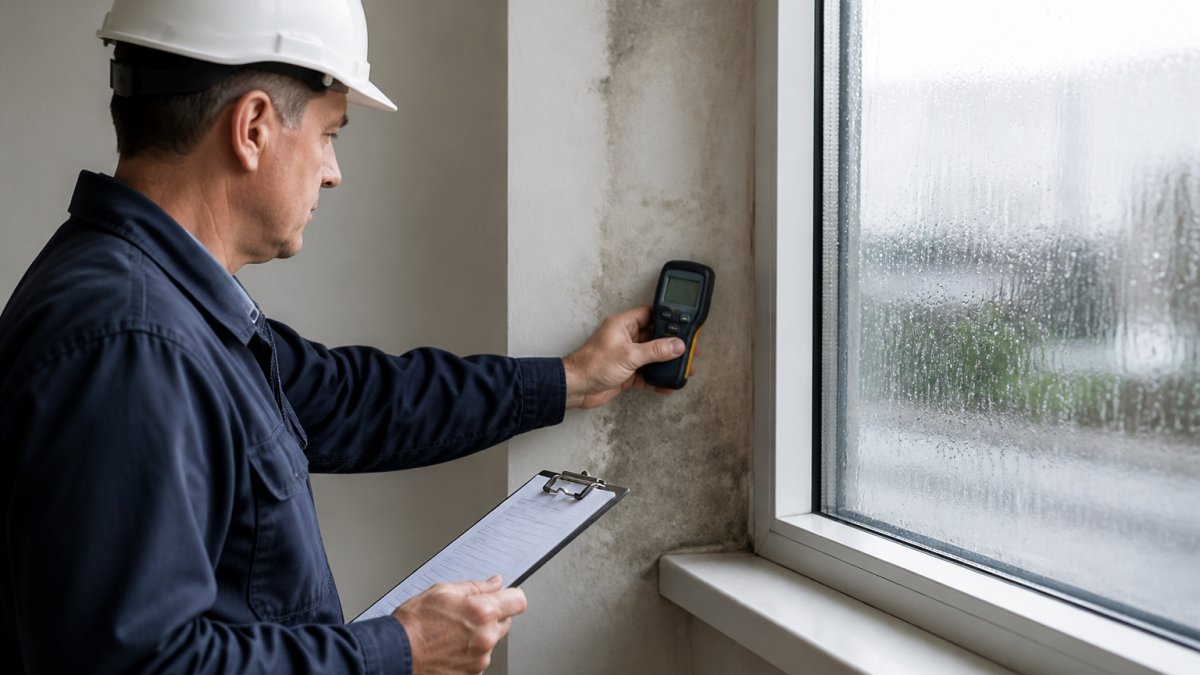
Step 1: Classify the moisture before you chase it
Most commercial moisture complaints fall into one of three categories, each with a different fix:
- Active leak or intrusion. Water is entering through a defect, a failed roof seal, cracked flashing, failed sealant joint, plumbing leak, or blocked condensate drain. Readings spike after rain or during equipment operation and dry out between events.
- Condensation. Water vapor in the air reaches a surface below its dew point and forms liquid. Readings track indoor humidity and outdoor temperature, not rainfall. Common on cold glass, uninsulated wall sections, thermal bridges, and the underside of roof decks.
- Capillary or stored moisture. Water wicks through porous materials, masonry, concrete, stucco, or remains trapped from a past event. Readings stay elevated even in dry weather and often spread laterally from a single point.
A moisture meter tells you where water is, not why. Pair readings with a hygrometer and dew-point calculation to separate the three categories.
Step 2: Walk the exterior and roof first
- Check grading and drainage. Soil should slope away from the foundation. Ponding within 10 feet of the wall is a red flag.
- Inspect downspouts and gutters. Water should discharge well away from the building, not against the base.
- Walk the roof and flashing. Look for ponding, torn membrane, failed seals at penetrations, and deteriorated counterflashing.
- Check the building envelope. Look for cracked sealant, open joints, gaps at windows and doors, and damaged cladding.
Step 3: Meter suspect assemblies and log readings
- Take meter readings at suspect walls, ceilings, and floors. Compare readings near exterior walls to interior control points. A spike near a window or roof edge points to intrusion; a broad, diffuse elevation points to condensation or stored moisture.
- Measure indoor relative humidity and dew point at the same time. If the surface temperature is at or below the dew point, condensation is the likely cause.
- Trace plumbing and HVAC. Slow supply-line leaks, blocked condensate drains, and failed drain pans hide for months. Check mechanical rooms and chases.
- Log everything with a date, location, and reading. A dated record tells you whether the problem is growing, seasonal, or event-driven.
Step 4: Prioritize corrective actions
Not every moisture finding is urgent. Rank them:
- Immediate (within 24-48 hours): active leaks, standing water, wet insulation, and any mold growth over roughly 10 square feet. These carry the highest risk of structural damage and indoor air quality complaints.
- Short term (within 30 days): failed sealant joints, blocked drains, condensate issues, and condensation on occupied surfaces.
- Planned (next budget cycle): envelope upgrades, insulation improvements, window replacement, and HVAC controls work.
This workflow catches what a visual walkthrough misses. Most moisture problems start small and spread quietly; classification keeps you from painting over a leak or replacing a window that only needed a dehumidifier.
Air Leakage, Vapor Diffusion, and the Building Envelope
Two forces move water into a building: air leakage and vapor diffusion. They are not the same and need different fixes.
Air leakage is air moving through gaps, cracks, and penetrations, carrying far more moisture than diffusion. Vapor diffusion is water vapor passing directly through materials.
The building envelope, the shell separating inside from outside, includes the air barrier, vapor barrier, and water-resistive barrier.
A common mistake is sealing one layer and ignoring the others. Moisture finds the weak point every time.
How to Lower Humidity in a Commercial Building
Lowering indoor humidity means controlling incoming moisture, air movement, and temperature. Attack all three, or the problem returns.
Start with these steps:
- Run the HVAC system correctly. It removes moisture when it runs long enough to dehumidify.
- Fix air leaks. Seal gaps around doors, windows, and penetrations.
- Use exhaust fans in kitchens, restrooms, and any wet process area.
The U.S. Department of Energy building envelope guidance explains that a tight, well-insulated envelope reduces both moisture intrusion and energy loss.
HVAC is the workhorse here. But a system sized only for temperature will struggle to control humidity.
Indoor Humidity Monitoring for Commercial Buildings: Targets by Use
Indoor humidity monitoring for commercial buildings works best with clear targets by space use, measured the same way every time.
| Space Type | Target Relative Humidity | Watch For |
|---|---|---|
| General office | 30-50% | Stuffy air, window fog |
| Retail floor | 30-50% | Condensation on glass |
| Restaurant kitchen | Under 60% | Grease plus moisture buildup |
| Storage and warehouse | Under 50% | Boxes softening, rust |
| Data or equipment room | 40-55% | Condensation on cold surfaces |
| Indoor pool or spa | Space-specific | Surface condensation, corrosion |
These ranges follow common industry guidance. Confirm exact targets with your mechanical engineer and adjust for climate, occupancy, and materials, a paper archive, server room, and loading dock do not share the same tolerance.
Relative humidity is the moisture in the air compared to what it can hold at a given temperature. Dew point is the temperature at which air can no longer hold its moisture.
Where to place sensors
Sensor placement determines whether your data is useful or misleading:
- Place sensors in occupied space, not on exterior walls. A sensor mounted on a cold exterior wall reads the wall surface, not the room.
- Keep sensors away from direct sun, supply diffusers, doorways, and heat-generating equipment. These create local readings that do not represent the space.
- Mount at roughly occupant height, about 4 to 6 feet above the floor, in the breathing zone where comfort and mold risk are assessed.
Calibration and data hygiene
- Calibrate or verify sensors at least annually, and after any relocation. Data loggers drift over time, and a drifted sensor can hide a developing problem.
- Use a reference hygrometer to spot-check installed sensors, and log the calibration date.
- Record readings on a fixed schedule, daily for critical spaces, weekly for general space, so trends are comparable.
How targets shift by climate and season
- Humid summers: dew point matters more than relative humidity. Keep indoor dew point below the temperature of the coldest surfaces in the space.
- Cold winters: indoor moisture from heating and occupancy can condense on cold walls and glass. Ventilation and source control matter more than dehumidification.
- Mixed and shoulder seasons: HVAC runtime drops, so dehumidification drops with it. Monitor closely and run systems long enough to remove moisture, not just to hit a temperature setpoint.
Review targets with your mechanical engineer whenever occupancy, equipment, or envelope conditions change, last year's right number may be wrong this year.
Commercial Building Condensation Prevention on Windows, Walls, and Roofs
Commercial building condensation prevention comes down to one rule: keep surface temperatures above the dew point. If a surface stays warmer than the air's dew point, water will not form.
Here is how to do it:
- Improve insulation to raise surface temperatures on walls and ceilings.
- Upgrade to double-pane or thermally broken windows to stop cold glass.
- Fix thermal bridging at framing and slab edges.
Roofs sweat from the underside when warm, moist air meets a cold deck. Ventilation and insulation fixes that.
Windows fog inside when indoor humidity is too high or the glass too cold. Both are fixable.
Moisture-Resistant Coatings for Commercial Buildings That Actually Hold Up
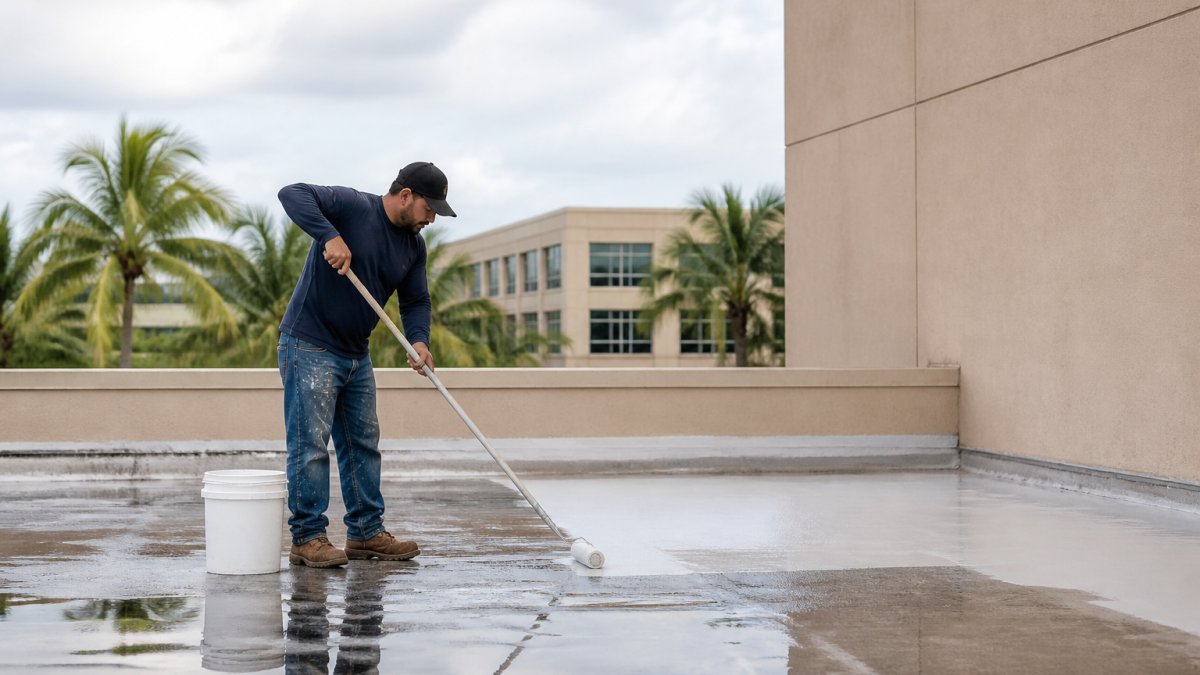
Moisture-resistant coatings for commercial buildings only work when the wall behind them is dry and sound.
What actually holds up:
- Breathable exterior coatings that let vapor escape instead of trapping it.
- Elastomeric coatings that bridge small cracks and flex with the building.
- Proper surface prep that removes chalk, mold, and loose paint first.
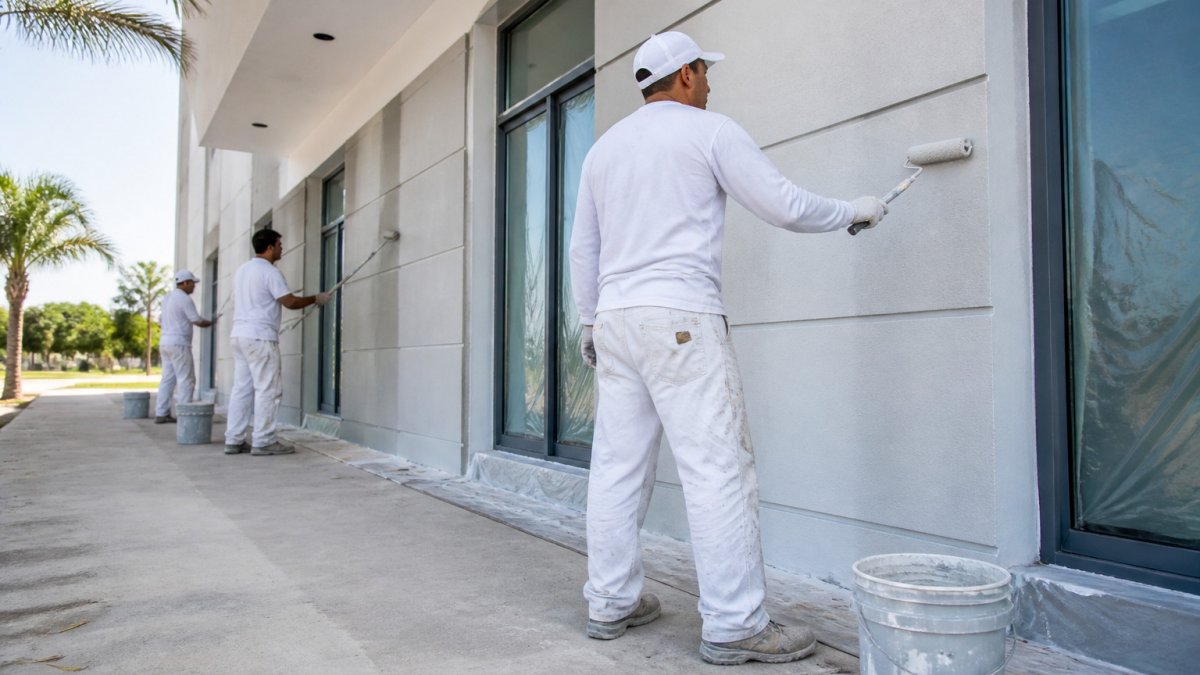
This is where Signature Coastal Coatings focuses: our process starts with meticulous surface preparation, because a coating is only as good as the surface under it.
Our finishes are built for heat, humidity, and salt air.
If a coating fails in a couple of years, that is a prep problem, not a paint problem.
Seasonal and Climate-Specific Strategies for Humidity Control
Humidity control differs by season and climate; what works in a dry summer fails in a wet one.
Seasonal playbook:
- Summer: Run the AC long enough to dehumidify. Watch for condensation on cold surfaces.
- Spring and fall: Manage shoulder-season humidity when HVAC runs less.
- Winter: Control indoor moisture from heating and occupancy. Watch for condensation on cold walls.
In coastal climates, salt air pulls moisture to surfaces and speeds corrosion, so coatings and sealants must be chosen for that exposure.
The National Institute of Standards and Technology building science resources offer technical guidance on moisture and envelope performance.
Cost matters too: fixing moisture early is far cheaper than replacing rotted framing, mold remediation, and repainting failed walls.
Conclusion
Moisture problems rarely fix themselves. They grow quietly until a small leak becomes a failed wall, a mold claim, or a tenant walking out.
Protecting commercial buildings from humidity takes a system: find the source, control the air and vapor, monitor the numbers, and use coatings that are built to last.
Get a free estimate from Signature Coastal Coatings and protect your building with finishes made for heat, humidity, and salt air.
Frequently Asked Questions
What indoor humidity level should a commercial building maintain?
Most commercial spaces target 30% to 50% relative humidity, a range consistent with ASHRAE guidance for occupant comfort and mold prevention. Retail and office space typically sits at the upper end, while data rooms, archives, and laboratories need tighter control, often 40% to 45%. Above 60% relative humidity, mold risk climbs sharply on cool surfaces. Set your target by how the space is used, then use indoor humidity monitoring for commercial buildings to confirm you stay inside that band year-round, including overnight and weekend hours when HVAC loads drop.
How can facility managers prevent condensation in commercial buildings?
Condensation forms when a surface drops below the dew point of the surrounding air. Commercial building condensation prevention comes down to three moves: keep indoor relative humidity below roughly 50%, keep surface temperatures above the dew point through insulation and thermal-bridging fixes, and stop humid outdoor air from leaking in through gaps, doors, and penetrations. Start by measuring both humidity and surface temperature at the problem spots, then address air leakage and insulation before adding equipment. Coatings help on exterior surfaces, but they do not fix a dew point problem on their own.
How quickly should a commercial building address water intrusion?
Mold can begin colonizing wet building materials within 24 to 48 hours, so the clock starts the moment water enters. Extract standing water and start drying within the first day, document everything with photos and moisture readings, and notify your insurer promptly. Structural drying typically takes three to five days with commercial air movers and dehumidifiers. Even a small roof leak or plumbing drip deserves the same urgency, because moisture trapped inside wall cavities or above ceiling tiles spreads well beyond the visible stain.
Can high humidity damage commercial building materials and finishes?
Yes, and the damage compounds over time. High indoor humidity swells wood framing and trim, softens drywall, corrodes metal fasteners, and lifts paint and caulk from exterior surfaces. On the outside, moisture intrusion through failed sealant joints or a compromised water-resistive barrier drives rot and mold inside the wall assembly. Moisture-resistant coatings for commercial buildings slow that process by keeping liquid water out while letting vapor escape, but they only perform when the substrate is dry and properly prepped. Budget for inspection and recoating on a schedule rather than waiting for visible failure.